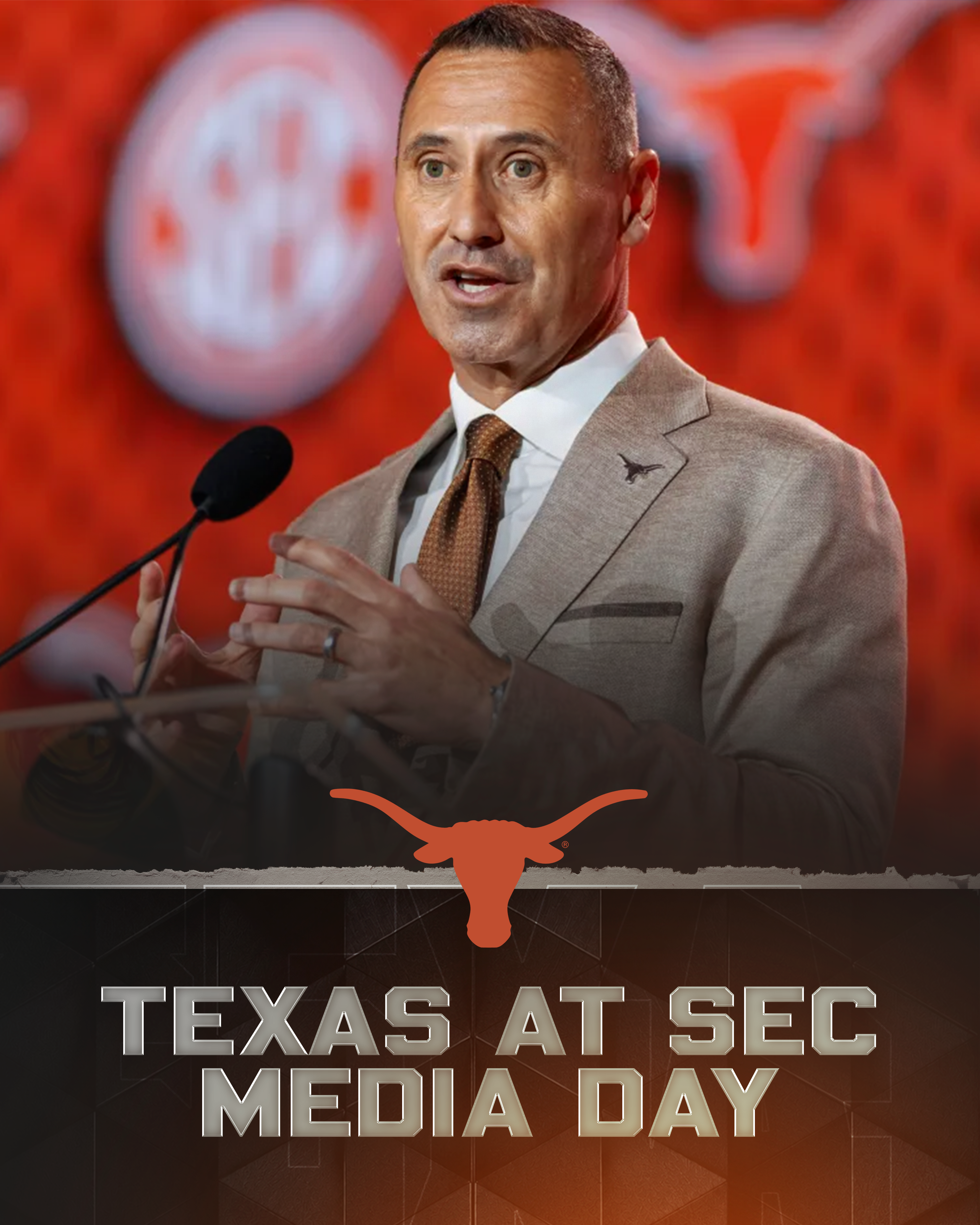

A year ago, Steve Sarkisian spent much of SEC Media Days answering questions about expectations that had been placed on a quarterback who had barely gotten the opportunity to prove himself. This time around, the conversation surrounding Texas quarterback Arch Manning is different.
Manning has now experienced a full season as the Longhorns’ starter. He has dealt with losses, criticism and stretches of inconsistent play. He has also shown the flashes that made him one of the most anticipated quarterbacks in college football.
Now Texas enters the 2026 season with Manning back under center, an upgraded roster around him and expectations that once again extend well beyond simply reaching the College Football Playoff. For Sarkisian, the biggest difference may not be anything Manning has changed mechanically. It is the confidence his quarterback developed by making it through everything that happened in 2025. "He's a lot more confident," Sarkisian said at SEC Media Days. "I think last season, he found out a lot about himself."
Sarkisian pointed toward the adversity Manning faced and how getting through it has affected his development as a leader. "Any time we're faced with adversity, and we get on the other side of it, you gain confidence," Sarkisian said. "I think that you see a different leader in him, in the way he interacts with his teammates." It is a noticeable change from the situation Manning faced entering last season.
Before Manning had established himself as Texas' full-time starting quarterback, expectations surrounding him had already reached enormous levels. His last name naturally contributed to the attention, but the hype surrounding his opportunity at Texas went even further. Manning was discussed as a potential Heisman Trophy candidate and future top NFL Draft selection before he had played a complete season as a starter. Sarkisian defended his quarterback against those expectations Thursday. "Arch Manning a year ago wasn't on social media or television saying he was going to win the Heisman Trophy, or be the first pick in the draft," Sarkisian said. Sarkisian added that the pressure Manning faced "would've ruined 95% of the people in his shoes."
Manning himself had attempted to temper those expectations entering 2025, acknowledging that he had not accomplished enough at Texas to justify some of the attention surrounding him. Then the season started, and the adjustment was not immediate. Manning struggled through portions of the first half of the year. Through his first six games, he threw 11 touchdowns against five interceptions as Texas' offense searched for consistency.
The Longhorns eventually suffered three regular-season losses, including defeats against Ohio State, Florida and Georgia. Despite finishing 9-3 and earning three victories over Top 10 opponents, Texas was left outside the College Football Playoff for the first time in three seasons.
Manning was forced to deal with something he had not experienced on that scale before: significant public criticism. Instead of allowing it to define his first year as the starter, he responded. Manning threw 15 touchdowns and only two interceptions during the second half of the season and increasingly began resembling the quarterback Texas expected him to become.
His development culminated in the Cheez-It Citrus Bowl against Michigan. Manning threw for 221 yards, rushed for another 115 and accounted for four total touchdowns in one of his most complete performances of the season. By the end of the year, the conversation was no longer entirely about what Manning had failed to accomplish. It had shifted toward what his improvement could mean for Texas in 2026. Sarkisian believes going through those struggles helped create the quarterback Texas has now. "He's very comfortable with who he is," Sarkisian said. "He's not trying to be something that he's not."
Manning also appeared much more comfortable addressing the expectations surrounding him during his appearance in Tampa. When asked about being labeled a potential "bust" during his struggles last season, Manning acknowledged that outside criticism can still provide some motivation. "Everybody has an opinion and gets paid to talk in the media," Manning said. "I'm trying to control the controllables. But, it probably lights a little fire in me, and continue to try and prove myself one week at a time."
That approach represents part of Manning's growth entering his second full season leading the offense. The expectations have not disappeared. If anything, they have increased. But there is now an entire season of evidence behind them. Manning has experienced SEC road environments, rivalry games, major wins and disappointing losses. He has been criticized nationally and responded with some of his best football. Instead of entering the season trying to prove why he deserves the hype, Manning enters 2026 knowing much more about what works for him as a quarterback.
He also appears comfortable keeping the focus inside Texas' locker room. Manning said the Longhorns attempt to keep issues such as NIL compensation from creating divisions within the roster. "We do a good job about not talking about NIL," Manning said. "I don't know how it is at other schools, that's big for us. It's about the players, and not worrying about how much someone makes." That locker room will be under enormous pressure over the next several months. Sarkisian doesn't appear interested in lowering the standard. "The expectations are a lot higher in our building than they are on the outside," Sarkisian said.
Manning's development is only part of why expectations remain so high in Austin. Texas used the transfer portal to strengthen an offense that was inconsistent at times in 2025, giving Manning additional talent entering his second season as the starter. One of the biggest additions is wide receiver Cam Coleman, who gives Texas another dynamic option in the passing game. The Longhorns are betting that a more experienced Manning combined with additional talent around him can produce an offense capable of competing with the best teams in the SEC. But the program's goals extend beyond simply having a productive offense. Texas expects to compete for a national championship.
That means eventually overcoming a program that has repeatedly stood in its way. Georgia has defeated Texas three times during Sarkisian's tenure, and Sarkisian made no attempt to avoid that reality at SEC Media Days. "If you want to be the champion, you've got to beat the champion," Sarkisian said. "We've lost to Georgia 3 times. Credit to Kirby, they've done a great job. If we want to be the champion, I'm guessing we're probably going to have to beat the champion."
It was one of the clearest statements of Texas' expectations entering the season. Reaching nine wins will not be viewed as enough. Beating several ranked opponents will not necessarily be enough. Even reaching the College Football Playoff may not represent the standard Sarkisian believes Texas has reached. The Longhorns have constructed a roster designed to contend for championships, and Manning's progression is central to whether they can finish the job.
Texas' absence from last season's College Football Playoff also continues to influence how Sarkisian views scheduling. The Longhorns finished the regular season 9-3 despite playing one of the country's more challenging schedules and collecting three victories against Top 10 opponents. Their reward was being left out of the playoff due to a loss to 4-8 Florida. That experience has Sarkisian questioning how much value programs should place on scheduling elite non-conference opponents if losses in those games can ultimately damage their postseason chances.
Texas already has several marquee non-conference games scheduled over the coming seasons. The Longhorns host Ohio State in Week 2 this September after losing to the Buckeyes last season. Michigan is scheduled to visit Austin in 2027 as the return game from Texas' trip to Ann Arbor in 2024. Beyond that, Texas has a home-and-home series scheduled against Notre Dame for 2028 and 2029. Whether those games ultimately take place appears less certain. "I don't know yet about Notre Dame," Sarkisian said. "We'll see, because I think the committee has to show us what happens now and what's the value that they're placing on strength of schedule and are we going to let a 9-3 team in as an at-large?"
The potential expansion of the College Football Playoff could play a significant role in that decision. A larger playoff field could make programs more willing to schedule difficult non-conference games because one early loss would be less likely to eliminate a team from championship contention. For Sarkisian, the calculation is relatively straightforward. "So is the juice worth the squeeze or not?" Sarkisian said. "That's what we're all tasked with." Texas' 2026 season could provide part of the answer.
The difference between Texas entering 2025 and Texas entering 2026 is experience. Last year, much of the excitement surrounding Manning was based on projection. There were flashes from his limited opportunities behind Quinn Ewers, his recruiting pedigree and the belief that Sarkisian could develop him into another elite quarterback. Now there is something more tangible. There is the quarterback who struggled early and responded. There is the player who finished the season considerably stronger than he started it.
There is the performance against Michigan that offered a glimpse of how dangerous Manning can become when both his passing and rushing abilities are working together. And perhaps most importantly, there is a quarterback who has already experienced what happens when expectations aren't immediately met. Sarkisian believes that experience changed Manning.
Manning appears to believe it did, too. The outside noise will remain unavoidable. His name alone guarantees that. Every Texas loss will be analyzed nationally, every mistake will become a discussion and every strong performance will bring the Heisman and NFL conversations right back. But Manning enters this season better prepared to handle it. The same can be said about Texas.
Sarkisian isn't pretending the expectations are unreasonable. He isn't attempting to portray the Longhorns as an overlooked team trying to surprise the SEC. Texas expects to win. And after missing the College Football Playoff despite nine victories and multiple Top 10 wins last season, there is little room for another year of almost getting there.
For Manning, that means proving the improvement Texas saw late last season can carry across an entire year. For Sarkisian, it means turning one of college football's most talented rosters into a championship team. And for the Longhorns as a whole, 2026 represents another opportunity to take the final step from national contender to national champion. As Texas left SEC Media Days, there was little ambiguity about what the program believes it can accomplish. The pressure is still there but they expect to win.